While FMCSA still in Phase 2 of ELD Implementation, December 16, 2019, is a critical date as the AOBRD grandfather provision expires. This provision allows fleets that had AOBRDs installed in their trucks prior to December 18, 2017, to continue using AOBRDs for two years following the ELD Compliance Date. Beginning December 16, 2019, motor carriers and drivers subject to the ELD rule must use self-certified ELDs that are registered with FMCSA.
The ELD rule applies to motor carriers and drivers who are currently required to keep records of duty service (RODS) under the hours-of-service (HOS) regulations. Drivers who use the time card exception, and don’t keep paper RODs, will not be required to use ELDs. The following drivers may keep paper RODS:
Drivers who keep RODS no more than 8 days during any 30-day period.
Driveaway-towaway drivers (transporting a vehicle for sale, lease, or repair), provided the vehicle driven is part of the shipment or the vehicle being transported is a motor home or recreational vehicle trailer.
Drivers of vehicles manufactured before model year 2000.
However, a carrier can choose to use an ELD, even if it is not required.
Hello there
Truckers, This article is also a reminder about the Pro-Rated HVUT Form 2290
for vehicles first used since February 2019. The Federal law indicates that the
Form 2290 must be e-filed by the last day of the month following the month of
its first use. On that basis, the Form 2290 is now due for vehicles first used
since February 2019.
The HVUT
form 2290 is basically an annual tax paid to the Internal Revenue Service for
vehicles that are used over the public highways and if the subjected vehicle’s
gross weight is at least 55000 lbs or more. This tax Form is basically due by
June and its payable until the end of August. (The current tax year is for the
period beginning July 1, 2018 through
June 30, 2019) and the due date for e-filing the Annual Form 2290 is
basically August, 31st.
The Form
2290 tax due is basically determined by the gross weight of the Truck and if
the truck seems to exceed the desired mileage limit for exemption. This is
drafted by the internal Revenue Service to be 5000 miles (For commercial based
units & 7500 miles for Agricultural based vehicles). If the subjected
vehicles seems to exceed the desired mileage for exemption, the taxes always
needs to be paid full in advance to the IRS for the respective period it’s been
reported.
E-Filing
Form 2290 has been made easy using www.truckdues.com,
The IRS digital watermarked copy of Schedule 1 will be emailed to you within
minutes after you e-file. Economic E-Filing begins here as low as $7.99.
Reach us back for any further assistance over the following
mediums:
Phone:(347) 515-2290 [Monday
through Friday, 9 A.M to 5 P.M, Central Standard Time]
Hello there
Truckers, over this article we are going to discuss about the changes that
could possibly made over a Filed Form 2290. Almost on a daily basis, we receive
calls from our users that they realized that something needs to be updated on
their E-Filed Form 2290. Now we are going to list out what is possible & what’s
not!
The 3
possible changes/corrections that could be made to a Filed 2290 are as follows
via an Amended Form 2290:
Increase in the Taxable Gross Weight
of the Truck.
Reporting a change on the Mileage
limit of exemption.
Reporting a change on the VIN
Increase in the Taxable Gross Weight
of the Truck
This scenario occurs when the HVUT Filer has
reported the vehicle’s gross weight to be minimum for example 55000 lbs, not
realizing the fact that the term taxable gross weight always refers to the
maximum weight of the truck ( Weight of
the Tractor + Trailer+ Load). Now in order for them to be able to report an
increase in the gross weight an Amended Form 2290 is filed to make the
difference in tax due payment to the IRS as well as to receive another copy of
schedule 1 for the corrected weight category.
Reporting a change on the Mileage
limit of exemption
As most of you are aware on the desired mileage limit of exemption set by the Internal Revenue Service, it remains to be 5000 miles for Commercial based units & 7500 miles for Agricultural based vehicles. When the subjected vehicle seems to exceed the desired mileage of exemption the vehicle turns out to be no longer exempt hence the tax due payment needs to be made to the IRS via an Amended 2290.
Reporting a change on the VIN
This is one of the most common interpretations
involved during e-filing Form 2290. Unavoidable human errors leads to
typographical errors on the VIN, which could later be updated via an Amended
2290 Form (VIN correction request). This process also lets the user to avoid an
over payment of taxes.
Things that can’t
be changed on a Filed 2290
Once the
Form 2290 is successfully filed and when the IRS issues the digital watermark,
the following changes can’t be reported online where the tax payer needs to
contact the IRS toll free help line @ (866) 699-4096 to get the changes implemented
over the phone.
Business
name/DBA
Address,
city, state & ZIP
Owners
Name.
Truckdues.com is rated to be one of the best priced websites
among many independent owner operators, we have gained our trust among them due
to our committed service where we ensure that are client’s inquiries are
addressed on time. E-file is simple and easy, receive the IRS digital
watermarked copy of schedule 1 back in your e-mail minutes after you e-file.
Reach us back for any further assistance over the following
mediums:
Phone:(347) 515-2290 [Monday
through Friday, 9 A.M to 5 P.M, Central Standard Time]
Hello there truckers, Over this article we are going to
discuss about the near –term HVUT Form 2290 deadline for vehicles that are into
service since February 2019. The Federal law states that the Form 2290 must be
filed by the last day of the month following the month of its first use. On
that basis, March 31, 2019 happens to be the deadline for vehicles first used
in February 2019.
Now before you are
going to e-file your pro-rated Form 2290, you need to figure out whether your
Truck is Taxable or Suspended. Basically there are 2 types of vehicles reported
in the Form2290 as follows:
Taxable vehicle: If your truck would
exceed 5000 miles for the Period beginning Feb 1st, 2019 through
June 30th, 2019 then your truck is classified to be a Taxable
vehicle, for which you are required to make a pro-rated tax due amount to the
IRS for the above mentioned period. The tax amount varies among the gross
weight of the vehicle.
Suspended vehicle: If your truck is
expected to be used under 5000 miles for the Period beginning Feb 1st,
2019 through June 30th, 2019, then your truck is classified to be a
Suspended vehicle, in other word an Exempt vehicle for which you’re not
required to make any tax payment however, you need to report the vehicle over a
Form 2290 under Suspended Vehicle to claim an exemption for the reported
period.
Calculate the Taxable Gross Weight of your vehicle:
When we talk about the taxable gross weight, it includes the
weight of the Tractor+ Trailer+ the maximum Load carried. Then enter the maximum
carrying weight of the vehicle on our application during your E-Filing process
so our inbuilt tax calculator would do the computation part by itself on your
behalf.
Economically E-File your HVUT Form 2290 via www.truckdues.com and receive the IRS
digital watermarked copy of Schedule 1 back in your e-mail instantly. Reach us
back for any further assistance over the following mediums:
Phone:(347) 515-2290 [Monday
through Friday, 9 A.M to 5 P.M, Central Standard Time]
The Form 1120 (officially
the “U.S Corporate Income Tax Return”) is one of the IRS tax forms
used by corporations (specifically, C corporations) to report their Income, Gains,
losses, deductions, credits and to figure out their tax liability.
Wondering why we are even discussing about a different tax than
Form 2290? Well we would like our Trucking community companies not to miss
their business corporation taxes. The Tax Form 1120 is generally due by March 15th, every year.
However for business that are involved in trucking are working restless to
address the nation’s needs on time hence there are greater chances to miss the calculation
part near the business tax deadline.
So you get a chance to claim an extension via Form 7004, It’s the form used to file for an automatic extension of time to file your business tax return for a partnership, a multiple member LLC filing as a partnership, a corporation, or s-corporation. The IRS indicates that, “Form 7004 does not extend the time for payment of tax.” Hence, you must pay taxes due (guesstimate) by your tax return due date, even if you file an extension application. You may also log on to the official IRS website to find the authorized e-file service provider to have your extensions filed successfully.
Now the bloodstream of our nation’s economy (Trucking) taxes
HVUT Form 2290 is also due by the end of this month on a Pro-rated basis. By
the federal law that states, that Form 2290 must be filed on a vehicle by the
last day of the month following the month of its first use. On this basis, the Pro-rated
Form 2290 is now due by March 31st,
2019 for vehicles that are into service since February
2019.
Our Tax experts stay dedicated to assist
you with your HVUT Form 2290 needs or working hours are from [Monday through Friday, 9 A.M to 5 P.M, Central Standard Time]. See you over the next article. Happy Trucking! Keep Moving
America Forward!
Hello there Truckers, doesn’t this question sound familiar to you? Almost on a daily basis, we receive calls as such inquiring about How do I/where do I report my truck that is not used above the desired mileage for exemption? The common misconception that evolves amongst many HVUT e-filers is that both these terms sound similar. However in terms of Form 2290 they are different attributes.
While
e-filing your HVUT Form 2290, you might
have noticed the section, Suspended/Exempt vehicles this section is basically
to report when the heavy vehicle is been used under the desired mileage limit
for exemption (5000 miles for Commercial
& Logging based Units) & (7500
miles for Agricultural based Units) In this case, you need not make any tax
payments to the IRS as they are exempt but you still got to report the vehicle
on this Form to legally claim an exemption.
On the
other hand, The Term Low mileage vehicle credits sounds to be referring to low
mileage or exempt vehicles, but in reality it’s related to Claiming a refund on
the Taxes paid full in advance on a low mileage vehicle. Upon realization of
the mileage recorded by the end of the tax period for which the tax payment was
made full in advance, you claim a full refund back from the IRS during the
renewal of the following tax year’s tax return.
Sounds confusing? Well here’s an example: John purchased a commercial utility vehicle in July 2018 and he needs to get his vehicles registered with the state authorities so does he needs to file a Form 2290 report. So he reported the vehicle on the Form 2290 (For the period beginning July 1st, 2018 through June 30th, 2019) and made an upfront tax payment to the IRS. However, due to unforeseen mechanical wear & tear unfortunately the truck was not used quite actively as he expected hence it recorded an overall mileage that is less than/below the actual mileage limit for exemption as (5000 miles)
Now, he’s got
to renew his Form 2290 for the upcoming period (For the period beginning July 1st, 2019 through June 30th,
2020. During this time, he’s got a chance to claim a full refund on the tax
paid for past tax year on the renewal form so evidently the tax due amount will
be nullified on the renewal form. On the other hand, If John does not seem to
own any trucks during the next renewal, he can simply claim a full refund (Form of cash) by filing the Form 8849 Schedule 6 ( Claim for refund of
excise taxes) and wait until 21 business
days to receive a refund check back in his mailing address.
Economically E-File your HVUT Form 2290 via www.truckdues.com and receive the IRS
digital watermarked copy of Schedule 1 back in your e-mail instantly. Reach us
back for any further assistance over the following mediums:
Phone:(347) 515-2290 [Monday
through Friday, 9 A.M to 5 P.M, Central Standard Time]
Hello there Truckers, we got a near term HVUT Form 2290 Deadline by Jan 31st, 2019 for vehicles first used since Dec 2018. The Federal law states that the Form 2290 must be filed on a vehicle by the last day of the month following the month of its first use. On that basis, now the Pro-rated HVUT is due by Jan 31st, 2019.
As the government
shutdown still persists, Filing your HVUT Form 2290 at the local IRS facility
would be merely impossible, hence it is advisable to e-file your HVUT Form 2290
online using our website www.truckdues.com
and receive the IRS digital watermarked copy of schedule 1 back in your e-mail
instantly.
Yes you
read that right, the Government shutdown does not seem to have any impact over
e-filed tax return as its purely computer based process. As there is no human
being involved in e-filing process at the IRS end who could possibly be a part
of the protest against the government.
More over
the E-Filing process is simple and elegant. It only consumes few minutes before
you complete the whole e-filing process. Simply register yourself on this
application and enter your vehicle information followed by the tax payment
option then you’d be able to transmit your tax return to the IRS post making
the service fee payment to our website using your Credit card.
As a result
of e-filing, you will be able to receive the IRS digital watermarked copy of
Schedule 1 back in your registered e-mail address within minutes after you
e-file. The same copy will nicely serve as the proof of filing to take care of
tags, licenses renewed during your vehicle registration.
Truckdues.com is rated to be one of the secured & simple
websites powered by Thawte & McAfee which
means our website can be relied upon this fact with no second thought. All the
data is encrypted so there is never a chance for a breach to any information
that passes through our website.
Reach us back for any further assistance over the following mediums:
Phone:(347) 515-2290 [Monday
through Friday, 9 A.M to 5 P.M, Central Standard Time]
Hello there
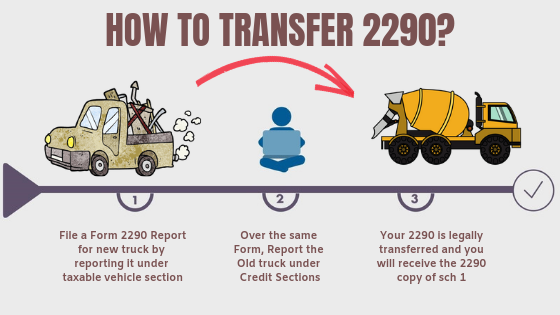
Truckers, most of you all would think how to transfer your 2290 from the old to
new unit. Well here’s the answer, it’s simply done over a regular Form 2290. Generally
when you e-file the Form 2290 you know that you always make the tax payment to
the IRS full in advance.
So if you
had sold a vehicle amidst a tax period for which you have made the tax payment
full in advance. You may certainly claim a partial refund or an adjustment of
tax credits to the replacement unit. If you had not bought any replacement unit
versus the sold vehicle you may simply opt for a tax refund which is done by
filing the Form 8849 Schedule 6 (Claim
for refund of excise taxes). Upon a successful submission of your claim
request, takes 21 business days
before the IRS could mail you the refund check.
On the other hand, if you had purchased a replacement unit versus the sold vehicle, you may go ahead and claim a partial credit carryover towards the Pro-rated tax due amount of the new replacement unit. By this way, you would be able to nullify your tax due (In case of same month remains in common for both sold & newly acquired unit) & pay the difference in excess post adjustment (In case of same month does not remains in common for both sold & newly acquired unit).
However, the vehicle that was sold would never reflect over your copy of
Schedule 1 as the IRS systems would only reflect taxable units and
suspended/exempt units determined based on the desired mileage use of the
vehicles. Whereas vehicles reported under credit sections would not show up on
the actual stamped version of Schedule 1 although it does remain accountable
for your credit adjustment in the backend.
Truckdues.com is rated to be one of the most efficient & cost
effective priced websites that support HVUT Form 2290 filings electronically.
We ensure zero tolerance towards any errors that might occur whilst the
e-filing process. The best part of e-filing is the turnaround time where it
just takes few minutes before receiving the IRS digital watermarked copy of
schedule 1 back in your e-mail.
Reach us back for any further
assistance over the following mediums:
Phone:(347) 515-2290 [Monday
through Friday, 9 A.M to 5 P.M, Central Standard Time]
Hey there truckers, this article is to indicate that we got
a near term tax deadline by Jan 31st, 2019 only for the Heavy
Vehicles which are operational on the road since Dec 2018. Despite that fact
that how many days the truck was operational throughout the month, the HVUT
would be due by the last day of the following month. Since, Form 2290 is due on
any vehicle by the last day of the month following the month of its first use.
Only when you’re truck is going to be used over 5000 miles
from the time you place the truck on the road up until June of the following
year, you pay taxes on the vehicle on a pro-rated basis by reporting your
vehicle to be a Taxable vehicle. (A Partial tax payment calculated from the
vehicle’s first used month through June of the following year).
Whereas, if the truck is going to be used under 5000 miles
and if you are affirmative about that fact, you may simply go ahead and report
your vehicle on a Form 2290 as a Suspended Vehicle ( Meaning it’s basically
exempt from paying taxes despite the number of months it’s really been used on
the highway)
E-filing your annual HVUT is isn’t a rocket science. It is
way simpler than you imagine. We got the most user friendly application setup
for you where e you’d be able to fill out your tax return by simply answering
few questions during the filing process and rest is been taken care by our
application in terms of generating your report in a PDF (Portable Document
Format) . Post reviewing your tax PDF, you may electronically transmit your tax
return to the IRS for acceptance.
As a result you’d be able to print the proof of filing
digitally watermarked by the Internal Revenue Service back in your registered
e-mail address within minutes for your documentation purposes. The same copy
can be used as the legal proof of filing during your vehicle registration
purposes.
Please feel free to reach our support team @ (347)
515 2290 [9. AM through 5 PM, Central Standard Time including weekends
and all major federal holidays] or write us: support@truckdues.com or Live
chat with our support team for instant help.
Hey there
Truckers, after a fortnight waiting period the IRS e-file servers are finally
back up online from Today. Hence, the IRS servers will be able to accept your
e-filed tax returns and be able to issue the digital watermarked copy of
schedule 1 for your vehicle registration purposes.
Now having
said that, the Government shutdown still persists at the moment which will have
an impact over the local IRS facilities & courthouses making most of the
walk in sites to be non-operational until the shutdown ceases.
For your
kind information, the IRS has a huge volume of 2290 tax return filed since the
downtime hence it may take until the end of today before the IRS could accept
all the tax returns that were filed during the maintenance period. So, we kindly request you to patiently wait
until the end of today before receiving the IRS digital watermarked copy of
schedule 1 back in your e-mail.
The Federal
law states that the Form 2290 musty be e-filed on a vehicle by the last day of
the month following the month of its first use. On that basis the Pro-rated
HVUT Form is now due by January 31st, 2019 for vehicles used on the
road since Dec 2018. E-File soon if you haven’t filed it yet.
Truckdues.com is rated to be one of the secured & simple
websites powered by Thawte & McAfee which
means our website can be relied upon this fact with no second thought. All the
data is encrypted so there is never a chance for a breach to any information
that passes through our website.
Reach us back for any further assistance over the following
mediums:
Phone:(347) 515-2290 [Monday
through Friday, 9 A.M to 5 P.M, Central Standard Time]